 Patrick Cooper
Key Takeaways
- F14 is a control board software fault: the microprocessor failed its own self-check and shut down heating rather than continue.
- One full power cycle at the breaker is the correct first response, and repeating it beyond twice changes nothing.
- A single F14 that never returns is usually a supply event; one that returns on the next bake is a board fault.
- F13 appearing alongside F14 points at failing stored configuration and makes board replacement the likely outcome.
- Do not run a self-clean cycle to test a suspect board — cavity heat is the harshest load the control ever sees.
The Bottom Line
Power the oven down at the breaker for five minutes and run one ordinary bake cycle. If F14 comes back, stop resetting it: the control board is the fault, and the replacement needs configuring for your exact model to work properly.
Most oven faults name a part you can point at: a sensor, a latch motor, a probe. The Electrolux oven F14 error code does not. It means a control board software fault — the microprocessor detected an execution error in its own program and stopped rather than carrying on with instructions it no longer trusts. That sounds alarming, and in one sense it is good news: an oven that catches its own fault is behaving exactly as designed.
| What you see | What it suggests | Next step |
|---|---|---|
| F14 once, clears after a power cycle, never returns | A one-off event, often a supply disturbance | Note the date and carry on |
| F14 returns within hours or days | Board fault, failing memory or supply quality | Book a diagnostic |
| F14 alongside F13 | The board cannot read its stored configuration | Board replacement is likely |
| F14 only during or after self-clean | Heat stress on the board behind the panel | Stop using self-clean until checked |
| F14 with a dead or flickering display | Power supply section of the board | Technician, do not keep resetting |
What a Software Fault Means on an Oven
The electronic oven control runs a small program that manages the elements, the fan, the door latch and the clock. It also checks itself: a watchdog circuit expects the program to report in on a fixed rhythm, and a memory check expects stored values to match. When either test fails, the board raises F14 and shuts the heating down instead of continuing.
That is a different thing from a broken component. The nearby codes are worth knowing for contrast. F13 is an EEPROM fault, where the board cannot read its stored configuration data. F10 is an open temperature sensor circuit, F11 is that sensor shorted. Those describe physical measurements. F14 describes the program itself failing a check, which is why swapping a sensor does nothing for it.
The One Reset Worth Doing
A single full power cycle is the correct first response, and it is the only one worth repeating once.
- Switch the oven off at the breaker, not at the control panel. The board holds power from the panel switch alone.
- Leave it off for five minutes so the supply capacitors drain and the memory genuinely restarts.
- Restore power and set the clock if the oven asks for it, which is normal after a full reset.
- Run an ordinary bake cycle at a moderate temperature and watch whether the fault returns.
- Write down what happened — the date, the code, and what the oven was doing when it appeared.
If the code stays away for weeks, it was almost certainly a supply event rather than a failing board. If it comes back on the next bake, further resets will not change the outcome and each one costs you a preheated oven.
Resist the temptation to test the oven with something in it. A board that has already failed one self-check can fail another partway through a bake, and finding out with a roast inside is both wasteful and a small fire risk if the door latch engages while the cavity is hot. An empty cavity at a moderate setting tells you everything a full one would.
Why a Board Starts Failing Its Own Checks
Three causes account for most repeat F14 faults, and only one of them is the board being old.
- Heat. The control sits directly above or behind the oven cavity. Self-clean cycles run the cavity far hotter than baking does, and a board that has taken several of them may fail checks that it passed for years.
- Supply quality. Voltage sags and surges upset the microprocessor. If other electronics in the house misbehave at the same moments, the wiring deserves a look before the oven does.
- Connections. A loose ribbon to the keypad or a corroded harness pin can feed the processor nonsense and trigger the same self-check failure.
- Age. Memory cells do wear. When F13 and F14 appear together, that is usually what is happening.
What Not to Do While You Wait
Do not keep the oven in service by resetting it before every meal. The board disabled heating because it stopped trusting its own instructions, and the door latch is on the same board — an oven that locks and will not release is a far more annoying failure than one that refuses to start. Do not run a self-clean cycle to see whether it still works; that is the single harshest thing you can do to a board already under suspicion.
If the oven is part of a range, keep using the surface burners only if they are independent of the failed control, which is usually true on a gas range and rarely true on an electric one. When in doubt, leave the appliance off at the breaker. Our Electrolux appliance safety guide covers when an appliance should simply be isolated.
Repair, and What It Involves
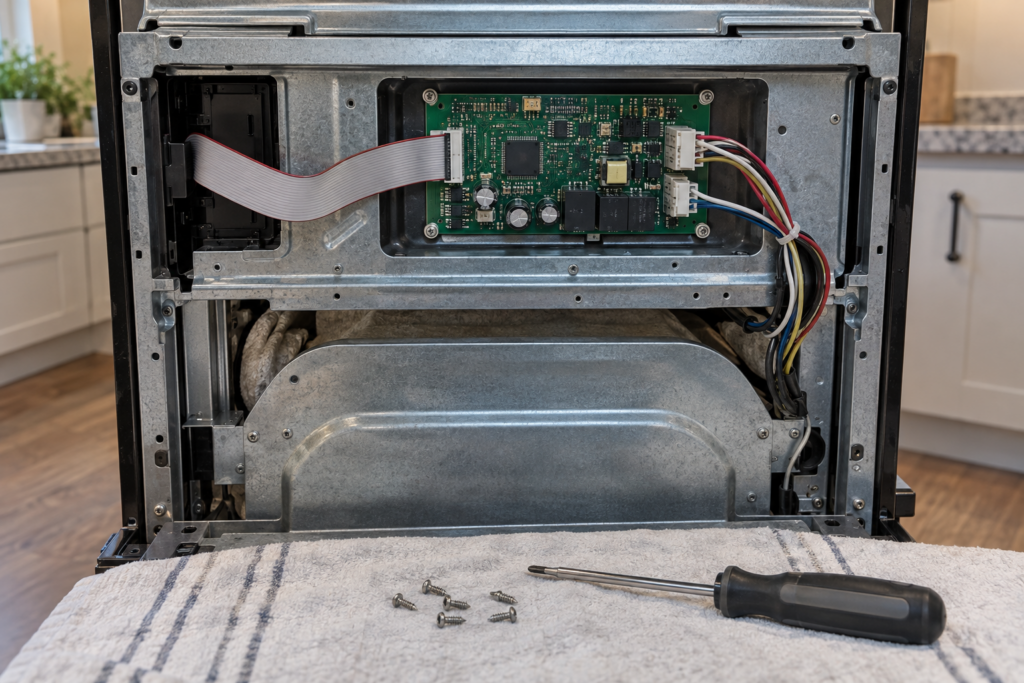
Replacing an electronic oven control is a contained job: the panel comes off, the board unclips from its standoffs, the ribbon and harnesses transfer across, and on many models the new board needs its configuration set for the exact model so the cavity, the latch and the probe behave correctly. That last step is why a board bought online and fitted at home often produces new codes rather than fewer.
Board parts are the expensive end of oven repair, starting from $160, and the arithmetic on an older oven deserves a look — our guide to Electrolux range and oven repair costs sets out what drives the number. Our oven repair service covers the control, the latch circuit and the sensors, with diagnostics from $120. The final price is confirmed after the on-site diagnosis and you get a written estimate before any work starts. You can book a visit or read the full detail on our F14 control board fault page.