 Patrick Cooper
Key Takeaways
- A completely dead oven points at the supply or the control board, not at an element or a sensor.
- An electric oven needs a dedicated 240-volt circuit, and a tripped double-pole breaker is the first thing to check.
- A breaker that trips again after one reset should be left off until the circuit and the oven are inspected.
- F13 is an EEPROM fault and F14 a software fault, and the site rates both as not safe to keep using.
- Do not open the control board, which holds components that need specialized equipment.
The Bottom Line
Check the breaker once, then the cord on a gas range. If the breaker trips again or the oven shows F13 or F14, stop and book service.
An oven that does not heat is one problem, and an oven that does nothing at all is another. When an Electrolux oven won't turn on, the display is dark or frozen, no button answers and no light comes on, and the cause sits in the supply to the oven or in the control board that wakes it, not in an element or a sensor. This guide sorts the possibilities in the order you can test them: the breaker, the circuit and the plug first, then the two control board codes the site lists, F13 and F14, and finally the signs that mean the oven should stay off. If the oven powers up but stays cold, our oven not heating guide is the better page.
| What you see | Most likely area | Safe check | Who fixes it |
|---|---|---|---|
| Dark display, no response, kitchen outlets fine | Tripped breaker or no power to the oven | Look at the double-pole breaker | You, or an electrician |
| Breaker trips again right after being reset | Overload or a fault in the oven or circuit | Stop, do not reset again | Electrician and technician |
| Display lights, then F13 on start-up | Control board memory fault | One extended power cycle | Technician |
| Display freezes, restarts or buttons act strangely, F14 | Control board software fault | Power cycle, watch if it returns | Technician |
| Gas range, display dark | Plug or outlet, since gas models need 120 volts | Check the cord and the outlet | You, then a technician |
What Should I Check First if My Oven Has No Power?
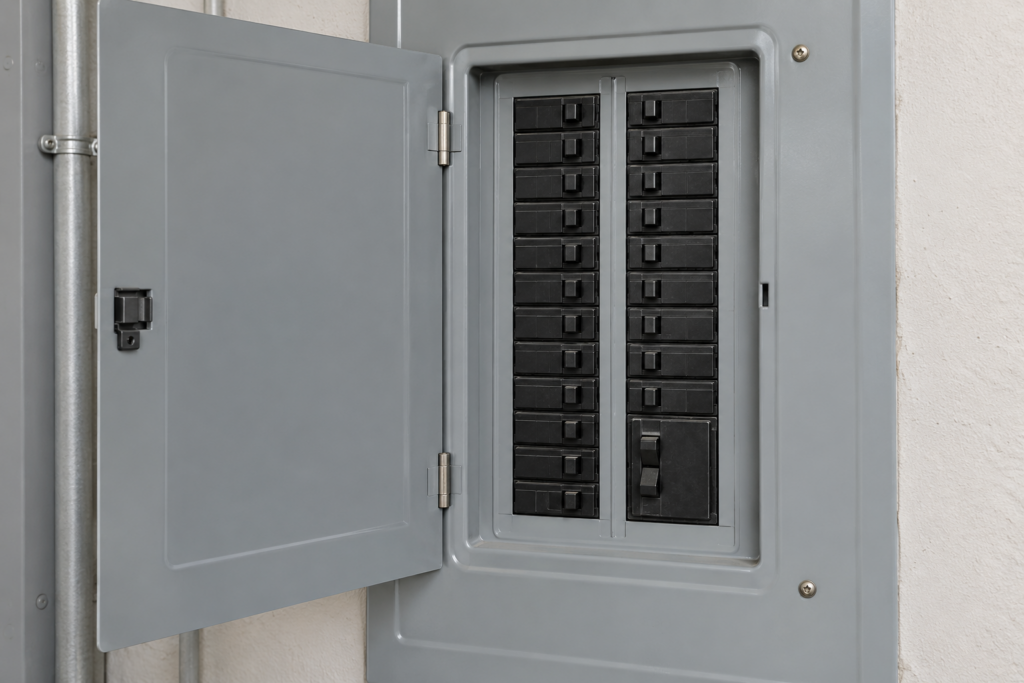
The circuit breaker, because an electric oven runs on a 240-volt circuit and a tripped breaker is the simplest explanation for a completely dead oven. Look for a double-pole breaker, two linked switches, that sits in the off or middle position, switch it fully off and on once, and see whether the oven wakes.
Our oven troubleshooting page makes the same point for ranges: electric ovens need 240 volts, and gas ranges need both a gas supply and a 120-volt outlet, so a gas range with a loose cord is dark even though the gas is fine.
- Check the breaker panel — a double-pole breaker that has tripped on one side can leave the oven partly or wholly dead.
- Check the plug and outlet on a gas range — confirm the cord is firmly seated.
- Check the clock and display — a display that never lights points at supply, one that lights and then locks up points at the board.
- Check for a power cut — an outage can leave the oven waiting for the clock to be set, which looks like a fault.
Why Does the Breaker Keep Tripping?
Because something is drawing more current than the circuit allows, or a part has failed to the point of a fault. Our electrical safety notice says that an electric range or oven needs a dedicated 40 or 50 amp, 240-volt circuit, and that if a breaker trips repeatedly while an appliance runs, you should stop using it and have both the circuit and the appliance inspected.
That advice is worth following to the letter. Resetting a breaker again and again does not fix a short, and a fire needs only a wire that overheats in the wall. The notice also lists the practices that cause nuisance trips and worse: sharing a circuit, using an extension cord and running on an undersized circuit.
- Reset the breaker once and see if it holds.
- If it trips again, leave it off. Do not try a third time.
- Do not use an extension cord or adapter to feed the oven.
- Book both checks. An electrician looks at the circuit, and a technician looks at the oven.
A burning smell at the outlet or the plug means unplug or switch off at the breaker immediately, and have an electrician inspect it before anything is powered again.
What Do F13 and F14 Mean on an Electrolux Oven?
Both are control board faults that can leave an oven unresponsive: oven F13 is an EEPROM fault, where the board cannot read its stored configuration data, and oven F14 is a software fault, where the microprocessor has had an execution error. The site rates both as not safe to keep using.
- F13 on start-up — all oven functions are locked out, settings or calibration may be lost, and it often follows a power surge, storm or breaker trip.
- F14, restarts and erratic buttons — the panel may go blank and restart, freeze, or change modes by itself before it locks out.
- Reset limits — the F13 page allows one extended power cycle, and the F14 page allows up to three, after which a code that returns means the board must be replaced.
Our oven F14 error code guide covers the software fault in more detail. Do not open the control board: the site notes it holds surface-mounted components that need specialized equipment.
What a Technician Does With a Dead Oven
The visit follows the order of the table above. The technician confirms the supply voltage at the oven, checks the wiring and connections and then reads the control board, so the board is only blamed when the power is proven good.
- Supply and connection — voltage, the terminal block and the connections at the back.
- Board and display — the stored fault history and the response of the controls.
- Safety checks — the oven stays out of use if any code calls for it.
The work belongs to our Electrolux oven repair service, and a diagnostic visit starts from $120.
After a Power Cut or Storm
A surge or an outage is a common trigger for both control board codes on this site, so it is worth knowing what is normal afterwards. After an outage the oven may simply need its clock set before it will run, and a short loss of power can freeze the display for a moment. Neither needs a repair. What does need attention is a display that does not recover, a code that appears at start-up or an oven that behaves differently from before.
- Set the clock first — many ovens wait for it after power returns.
- Give it one extended power cycle — switch the breaker off for several minutes, as the F13 page allows.
- Note what changed — lost settings, a different clock or random behavior all help the technician.
- Consider a surge protector at the panel — an electrician can advise, because surges are the commonest named cause of both codes.
If the oven is only a few years old, mention the purchase date when you book, in case any coverage applies.
Booking a Repair
Tell us whether the display is dark, frozen or showing a code, whether the breaker has tripped and whether there was a power cut or storm beforehand. Schedule a visit or contact us. The final price is confirmed after the on-site diagnosis, with a written estimate before any work begins.