 Patrick Cooper
Key Takeaways
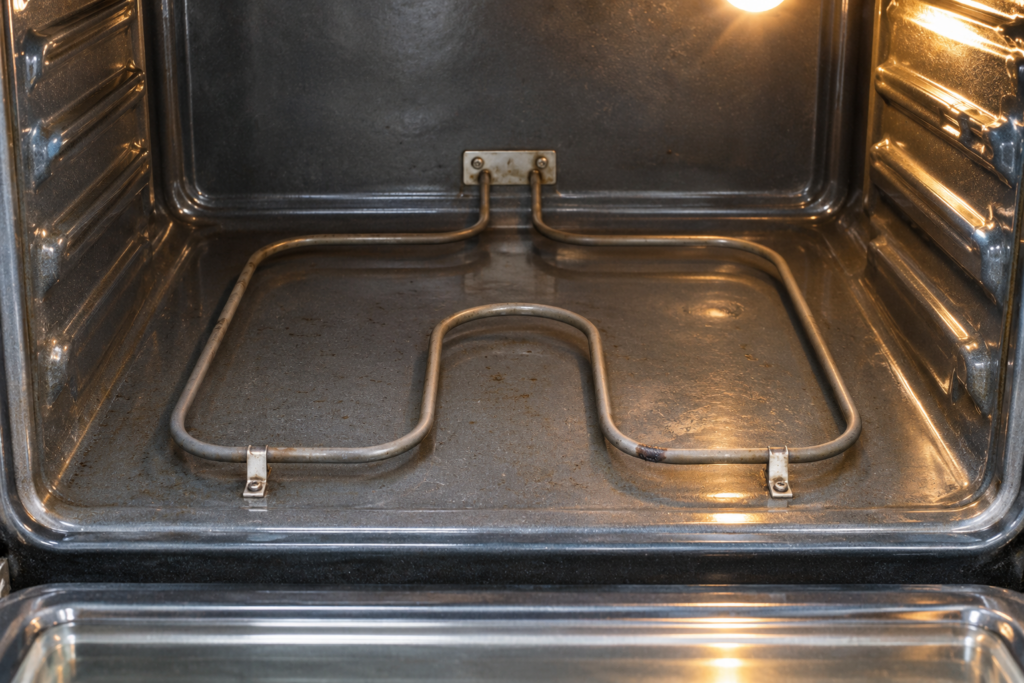
- A healthy bake element is a uniform dark gray, and blistering, bright spots, holes or a break mean it has failed.
- The bake and broil elements are separate parts, so bake can fail while broil still works.
- Bake element replacement is cost-effective at any age under 12 years on this site.
- A dark display or a drifting temperature points at power, the board or the sensor, not the element.
- Foil on the element and frequent self-clean cycles shorten its life.
The Bottom Line
Look at the element with the oven off. If it is blistered or broken, replacing it is one of the most cost-effective oven repairs there is.
The bake element is the coiled tube along the floor of an electric oven, and it does the heavy lifting in most recipes. It is also a consumable part: it heats hard and cools down every time the oven is used, so sooner or later the metal wears through. When that happens the oven lights up, the fan may run and the display counts the minutes, yet the cavity never gets warm enough to bake. This guide shows how to confirm the element is the culprit, what separates it from the sensor and the control board, and why it is among the easiest repair decisions in the kitchen. The wider question of whether an oven is worth repairing at all is covered in our range and oven worth repairing guide.
| What you see | Likely cause | Check | Worth repairing? |
|---|---|---|---|
| Oven runs but stays cold, element looks blistered or broken | Failed bake element | Visual check with the oven off and cool | Yes |
| Bake is weak, broil still works | Bake element, since the two are separate parts | Run each mode and compare | Yes |
| Oven heats unevenly or to the wrong temperature | Temperature sensor, not the element | Check the temperature with a thermometer | Yes, a different part |
| Display dark or frozen | Power or control board | Check the breaker first | Depends on age |
| Gas range that glows but never lights | Igniter, because a gas oven has no bake element | Watch the igniter while the oven heats | Yes |
How Do I Know the Bake Element Has Failed?
Look at it with the oven off and cool: a healthy element is a uniform dark gray with no breaks, bulges or discoloration, and a failed one shows blistering, bright spots, holes or a visible gap. The site's oven troubleshooting guide gives that exact test as the safest first step for a heating complaint.
Not every failed element looks damaged. Some break internally with no outward sign, which is why a technician confirms with a meter. The symptoms that point the same way are simple:
- The oven stays cold in bake mode — and the element at the bottom does not glow red.
- Broil works but bake does not — the top and bottom elements are different parts.
- Visible blistering or a break — the clearest sign, which a glance in the cavity settles.
- Slow, weak heating that gets worse over weeks — an element that is failing before it quits.
Is an Electrolux Oven Bake Element Worth Fixing?
Yes, almost always: our cost guide lists bake element replacement from $140 in total, which is a small fraction of the price of a new oven. The site's range and oven guide calls bake element and igniter replacements clearly cost-effective at any age under 12 years.
Ranges and ovens also have the longest life of any major kitchen appliance on this site, 13 to 17 years, so even an oven in its tenth year usually has several years left. Built-in wall ovens tip the balance further, since replacing one means matching a cabinet cutout and possibly rebuilding the cabinetry. The age bands in our parent guide help you place your own oven:
- Under 8 years — repair without hesitation.
- 8 to 10 years — element repairs are easy decisions, and a control board deserves a closer look.
- 10 to 13 years — worthwhile for lower-cost fixes.
- Over 13 years — only minor repairs make sense, because several parts may be near their end together.
What Else Looks Like a Failed Element?
A bad temperature sensor, a failed control board and a power problem can all produce an oven that does not heat. Ask a few questions before you buy a part, and a technician will ask the same ones.
- Does the display work? A dark display is a power or control board problem, and the oven F13 page covers one of the board faults.
- Is the temperature wrong rather than missing? A drifting reading points at the sensor, which our oven temperature inaccuracy guide explains.
- Is a code on the display? The site lists several oven codes on its oven F11 page and others, and a code tells you which circuit to test.
- Is it a gas range? A gas oven has an igniter in place of a bake element, so the same symptom has a different part.
The full list of heating faults is in our oven not heating guide, which also notes that an element in good condition is a uniform dark gray.
How Do I Make the New Element Last?
Treat the element gently and keep the oven clean. The site's guide says that aluminum foil placed directly on the element or the oven floor can cause hot spots that weaken the element over time. It also advises running the self-clean cycle no more than two to three times a year, because the extreme temperature, around 900°F, stresses the element, the sensor and the door lock.
- No foil on the element or the floor — use a baking sheet on a lower rack instead.
- Limit self-clean — and read our oven self-clean safety notice before you run one.
- Wipe up spills early — burnt-on grease on the element makes smoke and uneven heat.
- Keep an annual check — a technician catches sensor drift and element wear before they cause a code.
What the Repair Visit Covers
The technician tests the element with a meter, checks the sensor and the wiring, and then replaces the part. On a built-in wall oven the unit often has to be pulled partly out of its cutout to reach the rear connections, which the site notes adds labor. The estimate is written before work begins. The work belongs to our Electrolux oven repair service.
A Note on Wall Ovens and Ranges
The same element can sit in a freestanding range or in a built-in wall oven, and the repair is a little different in each. In a range, the technician can usually reach the element from the cavity and a few screws at the back wall. In a built-in, the oven often needs to be eased out of its cutout so the rear connections can be reached safely, which adds time and care around the cabinetry.
- Freestanding range — a quicker job on most models, with a gas igniter in place of the element on gas versions.
- Built-in wall oven — a longer visit, but the repair is still cheaper than replacing and refitting a built-in.
- Double ovens — each cavity has its own element, so say which cavity is affected.
Either way, switch the oven off at the breaker before anyone touches the wiring, and let the cavity cool completely before you look at the element.
Booking the Repair
Tell us the model, whether it is electric or gas and what the element looks like. Schedule a visit or contact us. The final price is confirmed after the on-site diagnosis, with a written estimate before any work begins.