 Patrick Cooper
Key Takeaways
- F90 and F93 mean the door latch motor is stuck or has failed, and F91 means the lock position switch is not responding.
- All three affect only the self-clean lock, so bake, broil and convection keep working.
- The code pages quote a typical repair from $200 in 30 to 60 minutes, usually worth doing on an oven with 13 to 17 years of expected life.
- If the door is locked shut, do not force it: let the oven cool, cycle the breaker for five minutes, and call if it stays locked.
- Cleaning the latch track and testing the latch by hand rule out two of the three causes before a motor is bought.
The Bottom Line
A latch motor repair is usually worth doing on an Electrolux oven, since the rest of the oven works and has years left. Stop using self-clean, never force a locked door and book a diagnosis.
Of all the oven faults that show up on a display, the door latch ones are among the strangest to live with, because the oven still cooks perfectly. Bake, broil and convection all work. What fails is the lock that makes self-clean possible, and the first time most owners learn about it is when a cleaning cycle ends with the door stuck shut and F90 or F93 on the display. The repair is small, but so is the case for doing nothing, which is why the worth-it question deserves a straight answer.
| Code | What the site says it reports | Who fixes it | Usually worth fixing? |
|---|---|---|---|
| F90, oven | Door latch motor stuck, cannot finish lock or unlock travel | You for a dry latch or debris, technician for a worn motor | Yes |
| F91, oven | Door latch switch not responding, no lock position feedback | You for the connector, technician for the switch | Yes |
| F93, range | Internal latch motor failure, runs but cannot complete travel | Technician | Yes, unless the oven is very old |
Is an Electrolux Oven Door Latch Motor Worth Fixing?
Usually yes, because the repair is small and the oven it protects has a long life ahead of it. The code pages on this site quote a typical repair from $200 and 30 to 60 minutes of work, while the site's range and oven guide gives ranges and wall ovens a lifespan of 13 to 17 years. This page is about the latch motor specifically; the whole-appliance view is in is it worth repairing an Electrolux range or oven, which is the parent of this guide.
The calculation tips only with age. The same guide says that on units over 13 years old only minor repairs are typically justified, which puts a latch motor repair at the edge for an oven that old. A built-in wall oven shifts the balance back, because replacing one means fitting a new cutout and sometimes cabinetry changes, and the site treats nearly any single-component repair on a wall oven as financially justified.
What Do F90, F91 and F93 Mean on an Electrolux Oven?
All three describe the door lock used for self-clean, and each points at a different link in it. Oven F90 says the latch motor is stuck and cannot complete its full travel. Oven F91 says the position switch is not giving the board any lock feedback. On ranges, range F93 says the internal latch motor has failed mechanically, and the board can hear it running while the latch does not move.
- F90 when you start self-clean — the motor cannot lock the door within the expected time, or you hear it try and fail.
- F93 with humming or straining — the motor is working against a seized or stripped gear train.
- F91 with a lock light that misbehaves — the control panel shows the wrong lock state, or self-clean aborts part-way.
- The door stuck locked afterwards — the latch could not retract once the oven cooled.
F91 is the one most often cured without a motor, because its three causes are all rated as possible for an owner to check:
- A failed position switch — heat from repeated self-clean cycles can weld the contacts shut or crack them open.
- A loose or corroded connector — the plug for the lock assembly may have worked loose, with separate pins for the motor and the switch.
- A latch that does not travel far enough — debris, worn gears or a slightly warped latch arm can stop it pressing the switch.
A distinct click at each end of the latch's travel, felt with the breaker off, tells you the switch is being pressed. No click at either end means the switch has failed or the latch is not reaching it.
Can You Keep Using the Oven With F90 Showing?
Yes, for normal cooking, as long as the door is not stuck in the locked position. The site's pages say all three codes affect only the self-clean lock, so bake, broil and convection stay available, and on a range the stovetop burners do too. The practical rule is to stop using self-clean until the lock is repaired, because a self-clean that cannot unlock afterwards leaves you with a hot oven you cannot open.
A power cycle clears the code and may release a stuck latch, but the mechanical issue remains and the code returns on the next self-clean attempt. That is why the display going quiet is a pause rather than a result.
What to Do if the Door Is Locked Shut
Do not force it. The site is emphatic that forcing the latch can damage the door frame and the lock mechanism permanently, and that spraying lubricant into the latch motor housing attracts debris and makes the problem worse over time.
- Let the oven cool completely. The page says to make sure it has fallen below 550 degrees Fahrenheit, because the safety interlock will not release the door at high temperature.
- Turn the oven breaker off for five minutes. Restore power, and the board may retry the unlock sequence.
- Stop if the door stays locked after several power cycles. A technician can release the latch by hand without risking the frame.
Our Electrolux oven self-clean safety notice explains why the lock matters during a cleaning cycle.
The Free Checks Before You Pay for a Motor
Two of the three causes behind F90 are not the motor, so look at them first. With the breaker off and the door open:
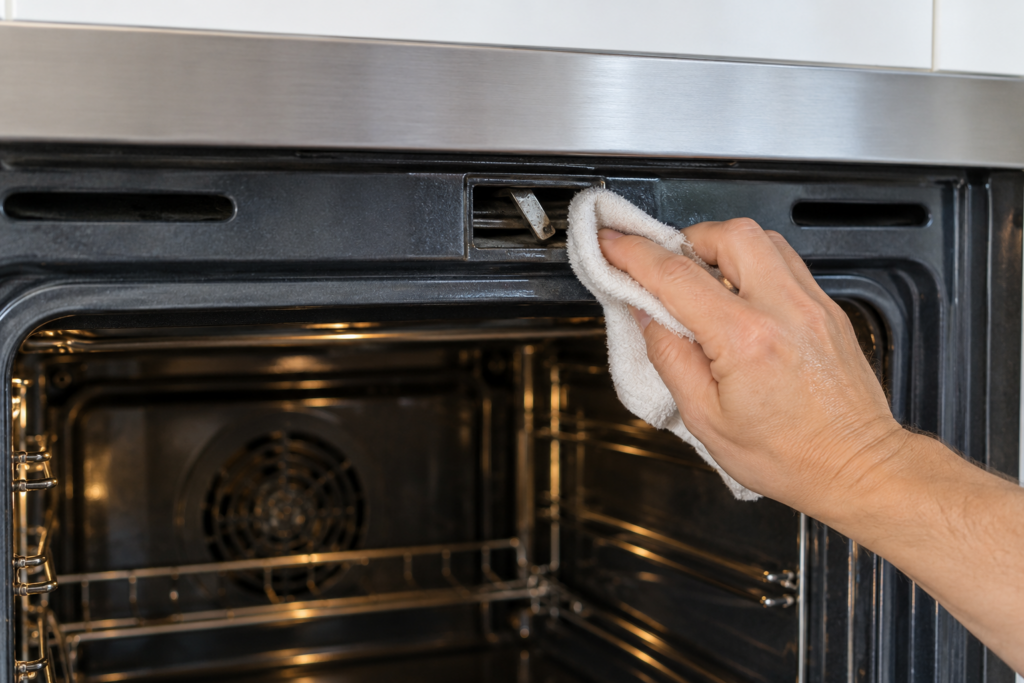
- Clean the latch track — wipe the guide slot at the top center of the oven opening with a damp cloth to remove carbon, grease and food.
- Test the latch by hand — slide the arm gently through its travel; if it moves freely by hand but fails under power, the motor is the culprit.
- Listen for the pattern — humming means a seized gear train, silence a dead motor and grinding stripped gears.
- Do not use oven cleaner on the latch — the chemicals can gum up the moving parts.
If the latch is clean and moves freely and the motor still cannot drive it, the assembly needs replacing, and on some ovens the lock sits behind panels that need the wall oven partly removed from its cabinet.
When Replacement Wins
Almost never on this fault alone. A latch motor is a small repair on a long-lived appliance, and the cases where a new oven makes sense are about the rest of the oven: a unit past 13 years that also needs a control board, which the site calls borderline on older machines, or one with several failures at once. Our Electrolux range or oven repair or replace guide covers that, and Electrolux range or oven repair cost prices the other parts.
If the oven also has trouble heating, see Electrolux oven not heating before attributing everything to the latch.
Booking the Repair
Latch motor and switch work is part of Electrolux oven repair for wall ovens and Electrolux range repair for freestanding ranges. Tell us the model, the code and whether the door is currently locked. Schedule a visit or contact us. The final price is confirmed after on-site diagnosis, with a written estimate before any work begins.