 Patrick Cooper
Key Takeaways
- F11 means the oven's NTC temperature sensor is shorted — reading an abnormally low resistance rather than a valid temperature.
- A sensor replacement starts from $95, making F11 one of the more affordable single-component repairs on this oven.
- F10 reports the opposite fault (an open circuit) but points at the same sensor and wiring.
- F11 is unrelated to F14, a control board software fault that is a considerably larger repair.
- Mentioning any other codes that have appeared recently helps a technician catch an upstream electrical issue affecting more than one part.
The Bottom Line
F11 is a single, well-defined sensor fault starting from $95 to repair — do not confuse it with the unrelated F14 board fault, which costs considerably more to diagnose and fix.
An Electrolux oven F11 error code means the oven's temperature sensor has shorted, and the F11 sensor replacement cost is one of the more predictable repairs on this appliance, because it's a single, well-defined part rather than a multi-component diagnosis. That predictability is worth knowing upfront, since F11 is often confused with the unrelated F14 control board fault covered in our other oven code guide, and the two repairs are priced very differently.
| Code | What this site records | Typical repair |
|---|---|---|
| F11 | Shorted oven temperature sensor — NTC resistance abnormally low | Sensor replacement — from $95 |
| F10 | Open temperature sensor circuit — no feedback to control board | Sensor or wiring — from $95 |
| F30 / F31 | Open / shorted temperature probe circuit | Probe replacement — from $95 |
| F14 | Control board software fault | Board diagnosis — a separate, larger repair |
What Does an F11 Error Actually Mean?
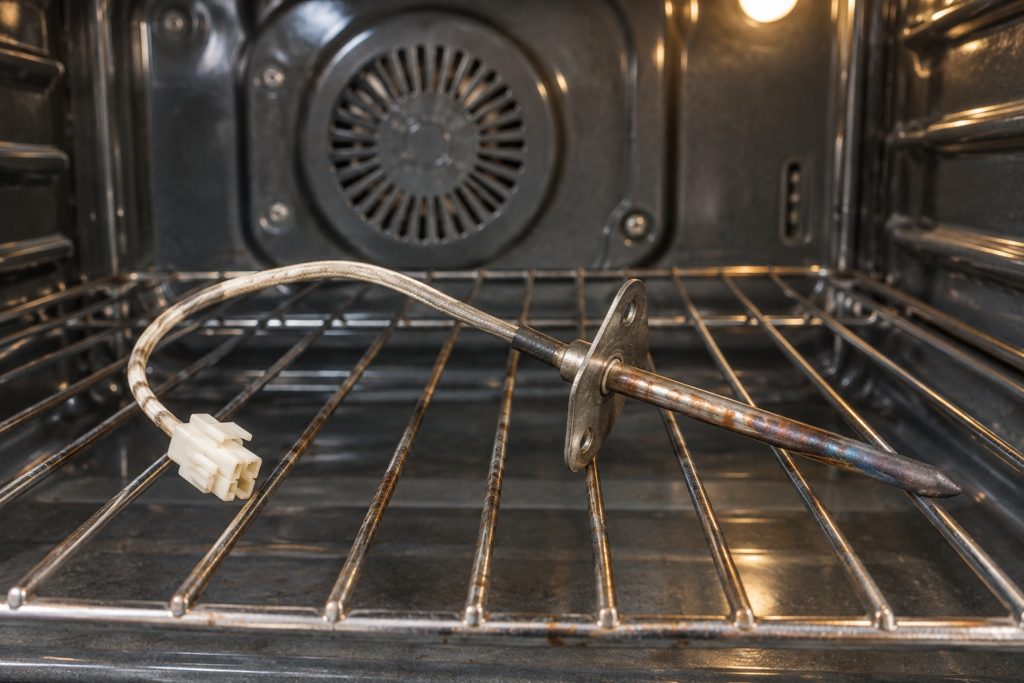
It means the oven's NTC temperature sensor is reading a resistance abnormally low for its expected range, which the control board interprets as a short in the sensor circuit rather than a valid temperature reading. This is different from F10, which reports the opposite failure — an open circuit with no signal at all — but both point at the same single component: the sensor itself or the wiring that connects it to the control board.
How Much Does Electrolux Oven F11 Repair Cost?
A temperature sensor replacement on this oven starts from $95 for parts and labor together, making it one of the more affordable single-component repairs this appliance needs. The final price is always confirmed after an on-site diagnosis, with a written estimate provided before any work begins, and the number can move slightly depending on whether the sensor itself or a section of wiring turns out to be the actual point of failure. This makes F11 one of the easiest oven repairs on this brand to budget for ahead of time, since the price range is narrow and the part itself doesn't vary much across the appliance's lifespan the way a discontinued board might.
- Sensor itself failed: the most common cause, and the more straightforward of the two to replace.
- Wiring or connector damaged: less common, but possible after other service work near the sensor location.
- Sensor position shifted: a sensor not properly seated against its mounting point can read incorrectly without being damaged.
- Contamination on the connector: grease or moisture at the connector can mimic a sensor fault electrically.
Is F11 the Same Repair as F14?
No, and confusing the two leads to the wrong expectation about cost. F11 is a single sensor — a small, inexpensive, well-understood part. F14, covered in our separate Electrolux oven F14 error code guide, is a control board software fault, and diagnosing and replacing a control board is a considerably larger job than swapping a sensor. If your oven has shown both codes at different times, it's worth mentioning that history when booking service, since it can indicate an electrical issue upstream of both components. Owners sometimes assume that because both codes start with F1, they must be related faults on the same part, but the numbering on this brand doesn't work that way — the second digit, not a shared prefix, is what actually identifies the specific circuit involved.
What to Check Before You Book a Repair
- Note the exact code — F10, F11, F30 or F31 point at slightly different sensor circuit faults.
- Check whether the oven still bakes at all, or refuses to start entirely, since that affects how urgent the repair is.
- Confirm the model number from the rating plate, since sensor part numbers vary across this brand's oven lineup.
- Mention if F14 or any other code has also appeared recently, in case the two are related.
Our broader Electrolux range and oven repair cost guide covers where a sensor replacement sits relative to other common oven repairs on this brand.
Testing the Sensor Yourself Before Booking a Repair
Somewhat — a multimeter check of the sensor's resistance against the manufacturer's published values for a given oven temperature can confirm whether the sensor itself is out of range, but reaching the sensor safely usually means removing an oven back panel with power disconnected, which is a bigger step than most owners want to take for a $95 part. The more practical owner-level check is simpler: note whether the oven's actual cooking temperature feels obviously off compared to the set point, since a shorted sensor often reports a lower resistance than reality, which the board reads as a colder oven than it actually is.
- Compare actual baking results against the set temperature using an independent oven thermometer, if you have one on hand.
- Note whether the fault is constant or intermittent, since an intermittent F11 can point at a loose connector rather than a fully failed sensor.
- Avoid probing the sensor circuit yourself unless you're comfortable working inside a disconnected oven cavity.
- Leave a multimeter check to the technician if you're not confident locating the sensor safely — it's a quick test once the back panel is off.
If the oven is running hot or cold without displaying any code at all, that's a different situation covered in our oven temperature inaccuracy guide, which walks through checks worth trying before assuming the sensor itself has failed.
How Much the Repair Cost Varies Between Oven Models
Not dramatically, since the sensor itself is a small, standardized part across most of this brand's single and double wall ovens and ranges — the from $95 figure holds fairly consistently across the lineup, with the larger cost driver being labor access rather than the part's price. A double wall oven, where the technician has to work around two cavities rather than one, can run slightly higher than a single oven or a range, mainly due to the additional time needed to access the correct sensor.
- Have your exact model number ready, since it confirms the correct sensor part before a technician arrives.
- Mention whether you have a single wall oven, double wall oven, or a range, since access time varies between them.
- Ask whether the quoted price already accounts for your specific configuration.
- Confirm the final price in writing before any work begins, as with any repair on this brand.
Booking the Repair
A temperature sensor is one of the more reliably priced repairs this oven needs, and a technician can usually confirm the diagnosis quickly given how specific the F10/F11/F30/F31 codes are. Our Electrolux oven repair service covers sensor and probe replacement, and a diagnostic visit starts from $120. The final price is confirmed after the on-site diagnosis, with a written estimate before any work begins.
Tell us the exact code when you book a visit or send us the details, and we'll let you know what to expect before the technician arrives.